Medicine Cabinet, Instrument Cabinet and Anesthesia Cabinet
All three cabinets are recessed stainless steel products with a plate thickness of 1~1.2mm. The cabinets may be fitted with doors or without doors (though the latter is unfavorable for management); the doors can be made as the sliding type or the side-hinged (swing) type. For sliding doors, the guide tracks should have no sharp edges, while also being convenient for hygienic cleaning. The opening angle of swing doors must reach 180 degrees. The door material can be glass or the same material as the cabinet body. The medicine cabinet and instrument cabinet should be set into the wall on the patient's foot side, while the anesthetic cabinet should be recessed into the wall on the patient's head side.
【Reference】 The overall dimensions of the three cabinets can be made identical or different. Even products from the same manufacturer are made in several styles for users to choose from, but the body dimensions can be determined according to the sheet material dimensions, generally not less than 900mm (width) × 1300mm (height) × 300mm (depth). The doors should be fitted with locks. Some products have drawers in the lower part of the cabinet, and between the cabinet and the drawers there is also a pull-out writing board. The cabinet can also be made in two sections, upper and lower; the lower section of the cabinet body is 600~800mm above the floor, which can be decided uniformly according to the dimensions of the selected cabinet. However, the height of the cabinet top above the floor should preferably not exceed 2m; any higher would be inconvenient to use.
All kinds of cabinets used in operating rooms must be fitted with a safety grounding terminal.
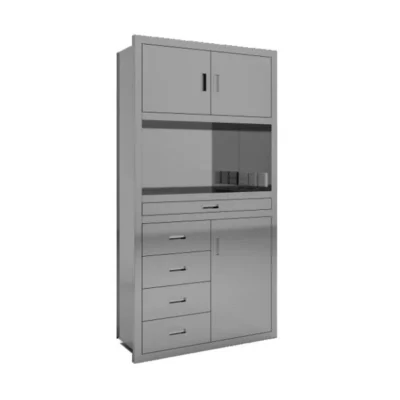
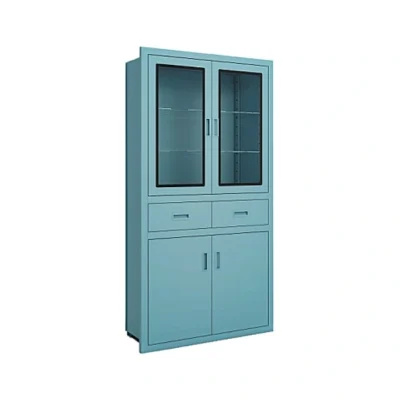
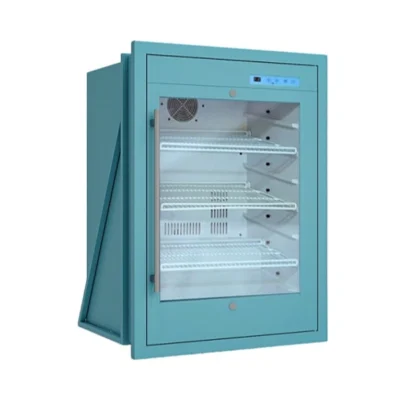
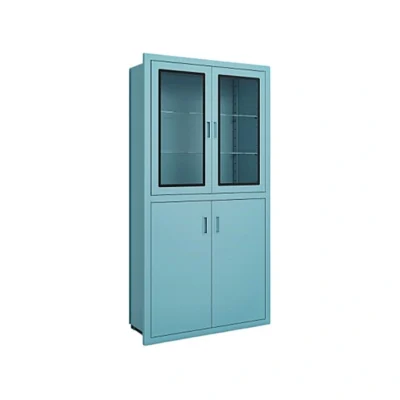
The appearance of the various cabinets is shown in Figure 6.16. Figure 6.16 Various special-purpose cabinets in the operating room