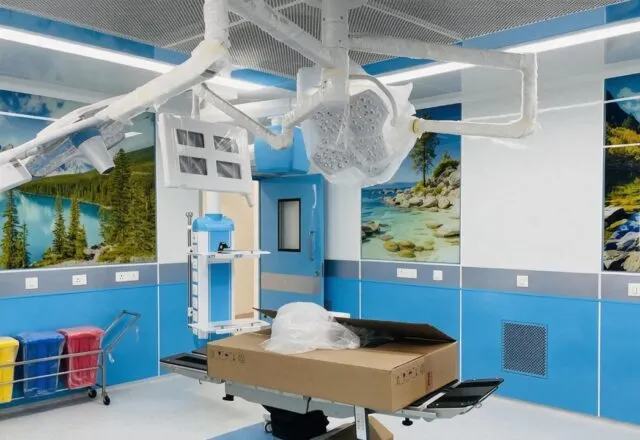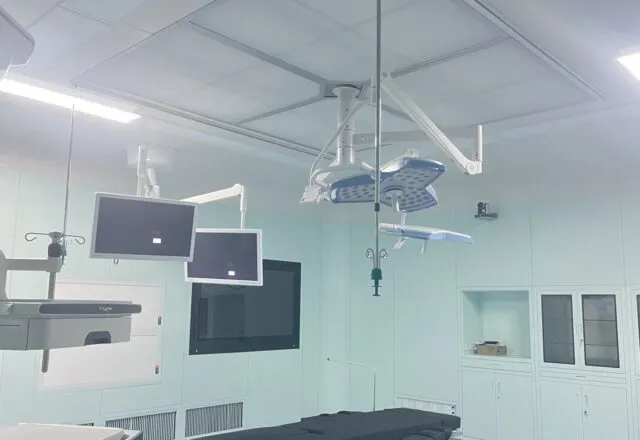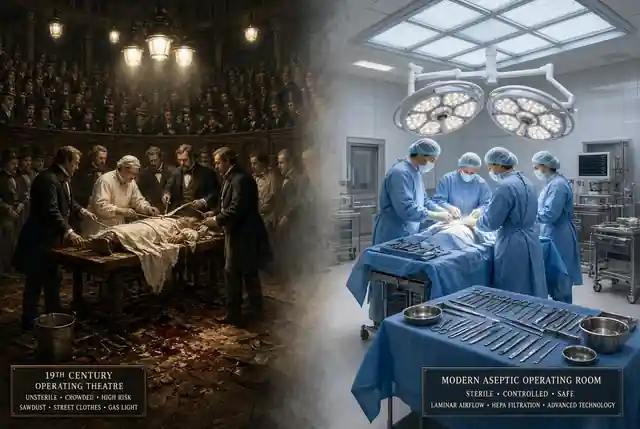
The operating room has undergone a profound transformation. What began as a crowded public “operating theatre,” where spectators gathered and the risk of infection was high, has become a carefully controlled aseptic environment in which clean air, equipment, and staff practices are managed as part of a single system. Germ theory and successive advances in infection control were central to this evolution.
Before the Mid-Nineteenth Century: The Public Operating Theatre
Before the mid-nineteenth century, surgery often took place in public teaching theatres. These spaces were open, crowded, and poorly lit. Surgeons commonly wore their street clothes, rarely washed their hands, and did not use gloves or masks.
Ether anesthesia appeared in 1846, but postoperative sepsis, hospital gangrene, and related infections remained major causes of death. For procedures such as amputations, infection-related mortality could exceed 40–50%.
Joseph Lister and the Antiseptic Era
Inspired by Louis Pasteur’s germ theory, Joseph Lister began using carbolic acid, also known as phenol, to treat compound fractures in 1865. In 1867, he published a series of papers in The Lancet that helped establish the principles of antiseptic surgery.
Lister’s methods included washing hands, soaking instruments in carbolic acid, applying antiseptic dressings to wounds, and spraying carbolic acid in the operating environment. Mortality in his wards reportedly fell from approximately 45% to approximately 15%.
This marked the beginning of the antiseptic era. However, Lister’s system relied primarily on chemical disinfection. It did not yet include the dedicated surgical clothing or completely aseptic environment that would develop later.
From Antisepsis to Asepsis
Gustav Adolf Neuber is described as the “father of asepsis.” In 1884, he proposed separating operating rooms for infected and non-infected cases. His private hospital in Kiel, built in 1885–1886, is described as an early hospital and operating environment designed strictly around aseptic principles.
Its features included:
- Washable tiled walls and floors, smooth surfaces, and glass cabinets.
- Preoperative disinfection with mercuric chloride.
- Sterilized instruments and separated clean areas.
- Attempts to heat and filter the air.
Several related developments during the late nineteenth century strengthened this new approach:
- Charles Chamberland and others developed steam sterilizers and autoclaves in the 1880s. Ernst von Bergmann and others subsequently applied steam sterilization to surgical instruments.
- William Stewart Halsted introduced rubber gloves in the 1890s, initially to protect a nurse’s hands from chemical irritation.
- Johann Mikulicz was associated with the introduction of surgical masks around 1897.
- Surgical gowns and caps became more common toward the end of the nineteenth century.
In the United States, Halsted, Charles McBurney, and others encouraged the use of dedicated clean operating rooms. Together, these developments shifted the emphasis from chemical disinfection alone toward preventing contamination through physical barriers and sterilization.
The Early to Mid-Twentieth Century
During the early twentieth century, public observation theatres gradually gave way to enclosed, dedicated operating rooms. Washable surfaces, ventilation, and standardized aseptic practices became increasingly important. The large-scale use of antibiotics in the 1940s further reduced postoperative infections.
Clean Air and Laminar Airflow from the 1960s
Sir John Charnley developed a vertical laminar-flow “Greenhouse” system and body-exhaust suits for total hip replacement. Infection rates reportedly fell from nearly 9% to below 1%.
In January 1966, Bataan Memorial Hospital in Albuquerque, New Mexico, established the first vertical laminar-flow clean operating room, using HEPA-filtered unidirectional airflow. Positive-pressure ventilation, HEPA filtration, and unidirectional, or laminar, airflow subsequently became important technologies in modern operating-room design.
The Modern Operating Room
Modern surgical departments are commonly organized as centralized units with strict personnel and material flows. Their environmental controls include cleanliness classifications as well as temperature, humidity, and fresh-air management. Digital integration and robotic-assisted surgery are also part of the operating room’s continuing development.
Clean operating rooms were promoted in China during the 1980s and 1990s. Relevant Chinese standards include the GB 50333 series.
Three Stages in the Development of Aseptic Operating Rooms
The development of the aseptic operating room can be understood through three broad stages:
- Chemical antiseptic barriers: Disinfectants such as carbolic acid were used to reduce microbial contamination.
- Physical aseptic barriers: Instrument sterilization, gloves, gowns, and caps helped prevent contaminants from reaching the surgical field.
- Clean-air control: Laminar or unidirectional airflow and HEPA filtration added environmental control to the aseptic system.
From carbolic acid to sterilized instruments, protective clothing, and HEPA-filtered airflow, each stage added another layer of protection. The modern aseptic operating room is the result of this cumulative progress in surgery, infection control, architecture, and environmental engineering.