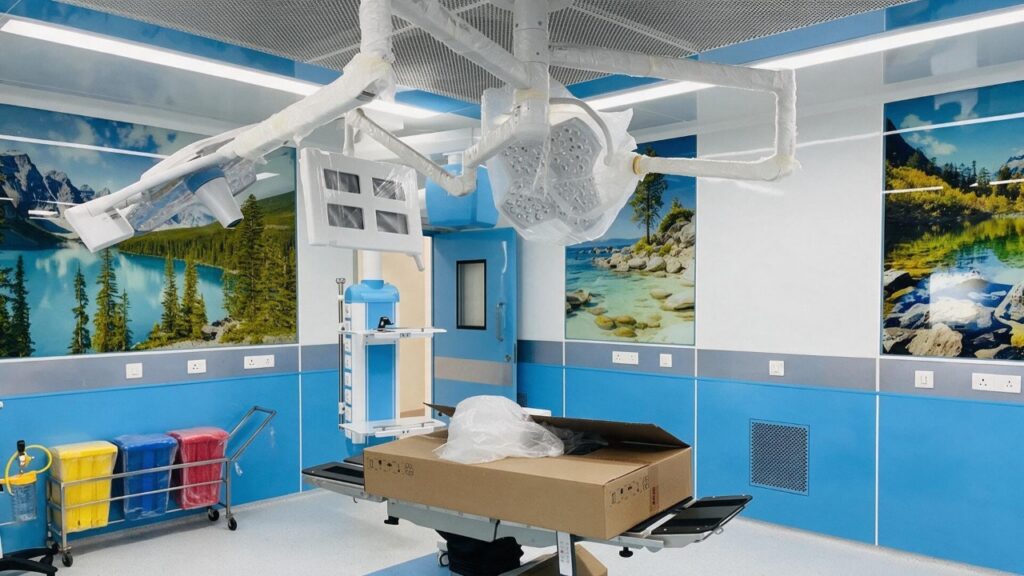
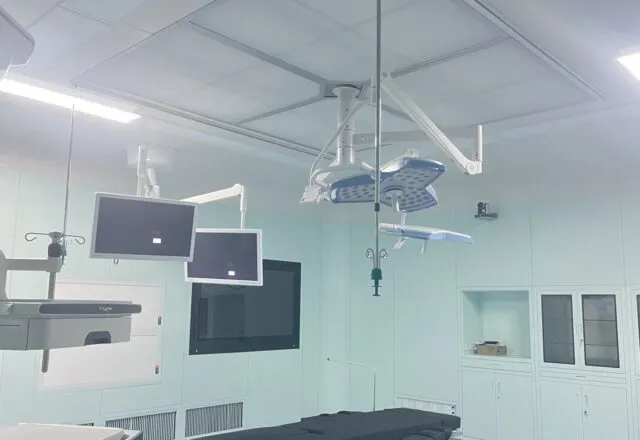
The global modular operating theatre market is approximately USD 3.5 billion (2024), projected to reach USD 7.2 billion by 2033 at a CAGR of ~8.8%. India is one of the fastest-growing regional markets, driven by the expansion of private hospital chains (Apollo, Fortis, Max, Narayana), medical tourism (ranked 10th on the Medical Tourism Index 2020-21), and rising infection-control awareness. Source: Verified Market Reports – Modular Operating Theatre Market However, India’s overall medical device sector still has an import dependency of 70–80%. Indian manufacturers can build the MOT “envelope” (wall panels, ceilings, doors), but core components — laminar flow ceilings, AHU automation, medical pendants, and high-end OT lights/tables — are still largely imported, with China as one of the main source countries (China accounts for 11–20% of India’s medical device imports depending on the data source; by some accounts 70%+ of finished goods/components involve Chinese supply chains). Sources: IBEF – Medical Devices Industry in India, ORF – China’s Shadow over India’s Medical Supply Chains, World Trade Scanner – 11% of India’s Medical Device Imports from China
2. Major Indian Manufacturers
The sector is dominated by SMEs clustered in Gujarat (Ahmedabad/Rajkot), Maharashtra (Mumbai/Pune), and Delhi NCR: Segment Representative Companies Envelope / cleanroom panels Hectra Enviro, Kaizen Airtreat (Pune), Sterimac Machinery (Ahmedabad), Apex Industries Turnkey MOT contractors Modular Healthcare System (Greater Noida), Gaddiel, hospital engineering firms Equipment (export-oriented lights/tables/pendants) Koinamedic, NSS (nsmot.com), Cognate India Sources: TradeIndia – Modular Operation Theatre Manufacturers, Apex Industries, Gaddiel, Hectra Enviro, Sterimac Machinery The high-end market is held by Western brands (Getinge/Maquet, Trumpf, Dräger, Steris); Indian manufacturers focus on the mid-to-low end and government tenders.
3. Export Destinations
Indian MOT systems and related equipment are mainly exported to: the Middle East (Gulf states), Africa, Southeast Asia, and neighboring South Asian countries (Nepal, Bangladesh, Sri Lanka). Some lights/tables/furniture makers also export to Europe and Latin America (e.g., Koinamedic lists Europe, Middle East, South America, Africa, and Southeast Asia). The typical model is turnkey hospital projects — “Indian engineering firm + Middle East/Africa hospital project” — rather than high-end single-product exports. Source: Koinamedic – Company, TVASA International
4. Indian-Made vs. Chinese-Made: Price and Quality
Dimension Indian-Made Chinese-Made Price (turnkey OT, comparable spec) Indian MOT ~₹850,000–3,000,000+ per room (~USD 10k–35k+, envelope-focused); lower total contract prices Chinese panels, doors, and laminar-flow components are typically 20–40% cheaper ex-works, but the gap narrows after freight, duties, and CDSCO registration costs Quality Envelope work is acceptable; weaker in laminar-flow control, hermetic doors, smart integration; inconsistent QC among small firms Top Chinese manufacturers (listed cleanroom engineering companies) have mature processes and good consistency; low-end small factories vary widely Delivery & service Local installation and fast after-sales response — a decisive advantage, since MOT is essentially a construction project, not a product Remote after-sales is difficult; requires local agents Certification Easy domestic CDSCO registration Requires CDSCO import registration; government procurement also imposes country-of-origin restrictions Sources: TradeIndia – OT Door Prices (₹850,000/unit example) / TradeIndia – Operation Theater Doors, Medical Device Registration – Importing from China to India (CDSCO)
5. Which Do Indian Hospitals Prefer — Indian-Made or Chinese-Made?
For the envelope and turnkey MOT engineering: a clear preference for Indian-made. Reasons: Mandatory policy: The Public Procurement (Preference to Make in India) policy and the National Medical Devices Policy 2023 require government procurement to prioritize domestic suppliers (local content thresholds). GeM platform tenders commonly include clauses such as “supplier must have a service center in India,” effectively excluding pure Chinese suppliers. Sources: National Medical Devices Policy 2023 (DoP), PIB – Cabinet Approves Medical Devices Policy, GeM MOT Technical Specification example MOT is installation- and service-heavy; hospitals are unwilling to take cross-border service risks. For equipment and components: Chinese products are actually used in large volumes. Among OT lights, operating tables, pendants, and electrosurgical units procured by private hospitals, Chinese brands (Mindray, Comen, etc.) and white-label products have high penetration. Since India eased trade restrictions on China in 2025, China’s medical device share has been rising. Hospitals are “Make in India in speeches, price-performance first on purchase orders”: budget-constrained private and secondary hospitals willingly buy Chinese equipment, while high-end private hospitals (JCI-accredited, medical-tourism-oriented) choose Western brands. Source: Medical Buyer – India Lowers Its Chinese Trade Wall: Impact on MedTech Bottom line: For MOT engineering projects themselves, Indian hospitals (especially public ones) favor Indian turnkey contractors; but broken down to the equipment list, Chinese-made components and finished products account for a large share, often in a hybrid “Indian integrator + Chinese components” model. The most realistic path for Chinese exporters is to become upstream suppliers to Indian MOT integrators rather than bidding on hospital projects directly. Note: Price ranges come from TradeIndia/IndiaMART listed prices and GeM tender specifications — they are indicative market quotes, not exact transaction prices. Compiled October 2026.