Event Overview and Venue
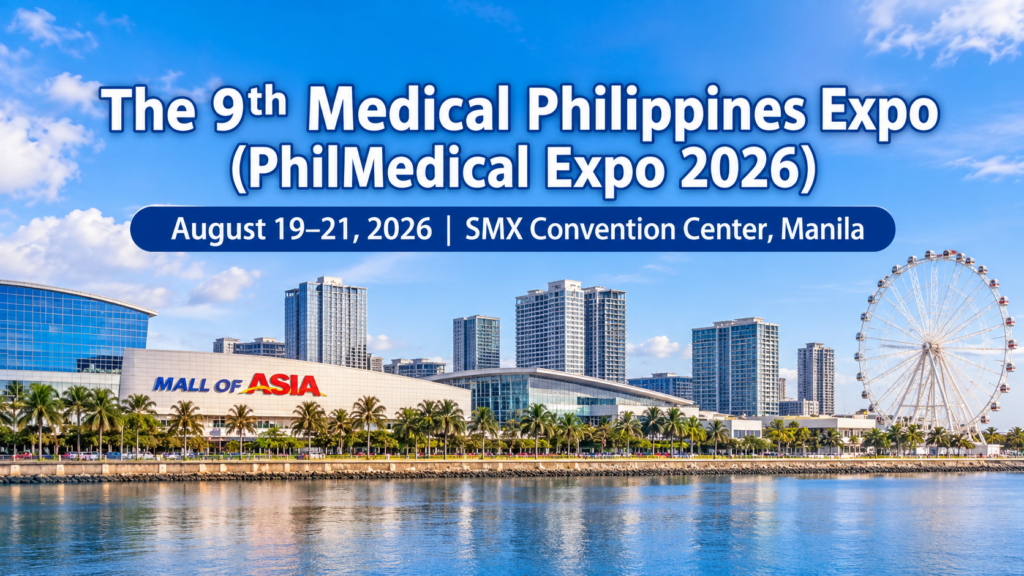
The three-day exhibition will run from 10:00 to 18:00 daily across Halls 1–4 of the SMX Convention Center, located at Seashell Lane, Mall of Asia Complex, Pasay City, Metro Manila. Situated inside Manila’s core Mall of Asia commercial district, the venue offers the facilities and transport capacity required for large-scale international trade events. The mid-August timing deliberately avoids Southeast Asia’s year-end holiday period and the year-start budget-planning season, aligning with the medium- and long-term equipment procurement and annual budget execution windows of both public and private healthcare institutions.| Key Parameter | Official Specification |
|---|---|
| Full event name | The 9th Medical Philippines Expo (PhilMedical Expo 2026) |
| Schedule | August 19–21, 2026 (3 days; halls open daily 10:00–18:00) |
| Venue | SMX Convention Center, Halls 1–4, Pasay City, Metro Manila |
| Full address | Seashell Lane, Mall of Asia Complex, Pasay City, Metro Manila, Philippines |
| Organizer | Fireworks Trade Exhibitions & Conferences Philippines, Inc. |
| Official contact | Tel: +632 8790 0168 / +632 7000 6392 · Email: [email protected] |
| Co-located shows | INDEC (Infectious Disease Control), Dental Expo, Medical Technology Expo, Eldercare Technology Expo |
What Is on Display
The exhibition spans the entire modern healthcare value chain, with a strong emphasis on medical automation, clinical diagnostics, and infrastructure upgrades.Clinical equipment and critical care
High-end medical electronics and imaging equipment form a centerpiece of the show, including computed tomography (CT) scanning systems, magnetic resonance imaging (MRI) systems, digital X-ray machines, high-resolution color Doppler ultrasound, and integrated operating room systems. The emergency and intensive care (ICU) zone features manual resuscitators (BVM), anti-asphyxiation suction and debridement equipment, defibrillators, endotracheal intubation supplies, anesthesia masks, and a full range of catheters and other life-support consumables.Laboratory medicine and IVD technology
The diagnostics segment highlights the automation and precision of in-vitro diagnostics (IVD), showcasing fully automatic electrolyte analyzers, clinical chemistry analyzers, hematology analyzers, IVD reagent kits, and Laboratory Information Management System (LIMS) interface technology. The lineup responds to pressing demand from local mid-sized and large clinics for automated laboratory workflows.Dental, infection control, and eldercare
- Dental zone: dental imaging, treatment chairs, orthodontic materials, and digital processing equipment.
- INDEC: air disinfection and purification, harmless medical-waste treatment, and high-grade protection systems.
- Eldercare, rehabilitation, and orthopedics: orthopedic implants, prosthetics and orthotics, spinal fixation systems, and smart home eldercare monitoring terminals, aligned with the health-management needs of an aging population.
Healthcare IT and building technology
The digital and infrastructure segment features Hospital Information Systems (HIS), telemedicine collaboration platforms, and smart-hospital building energy-management systems, supporting the digital transformation and green-infrastructure upgrade of Philippine hospitals.Exhibition Scale and Regional Reach
PhilMedical Expo is the most influential healthcare B2B trade show in the Philippines and occupies a strategic position within the ASEAN medical supply-chain system. The 2026 edition is expected to feature:- 30,000–50,000+ square meters of gross exhibition area across ground-level Halls 1–4;
- 200+ exhibitors from more than nine countries, including China, Germany, South Korea, India, and Japan;
- 15,000–20,000+ trade visitor attendances, spanning health administrators, hospital directors, distributors, and researchers;
- Coverage of all three Philippine island groups — Luzon, Visayas, and Mindanao — with reach extending into the wider ASEAN market.
Visitor Guidelines: Admission, Dress Code, and Access
Entry is strictly limited to professional trade visitors in the healthcare sector and is not open to the general public. Admission is free for qualified industry professionals, who may pre-register through the official website or present a business card at the on-site registration desk in exchange for a visitor badge.- Security and badges: Visitor badges are personal and non-transferable. Security personnel may request valid identification at any time, and persons aged 17 or under are not permitted on the show floor.
- Dress code: Business attire or smart casual is required. Shorts, slippers, sandals, and sleeveless tops are prohibited, and visitors who do not meet the dress code will be refused entry.
- Transport: Take the LRT to EDSA station or the MRT to Taft Avenue station, then transfer to a MOA shuttle bus or taxi to Seashell Lane. From Manila International Airport (NAIA), the venue is roughly 15–20 minutes by coupon taxi or Grab.
- Accommodation: Official partner hotels include the adjacent Conrad Manila.
PFDA Compliance: What Foreign Exhibitors Must Know
International exhibitors need to plan around the regulatory framework of the Philippine Food and Drug Administration (PFDA). Under the Food and Drug Administration Act (RA 9711) and related administrative orders, foreign manufacturers cannot hold licenses directly. They must either establish a local subsidiary or authorize a local distributor or importer holding a valid PFDA License to Operate (LTO) to act as their legal authorized representative. Market access for medical devices follows a risk-based pathway:- Appoint a local license holder — a local subsidiary or an authorized distributor/importer with a valid PFDA LTO.
- Notify or register the device — low-risk Class A devices require an online application for a Certificate of Medical Device Notification (CMDN), while Class B, C, and D devices require submission of the ASEAN Common Submission Dossier Template (CSDT) and PFDA review leading to a Certificate of Medical Device Registration (CMDR).
- Import and deliver lawfully — CMDR certificates are generally valid for five years, and products may be commercially imported and delivered only after registration through the authorized local agent.
What Happened at the 2024 and 2025 Editions
Recent editions demonstrated the expo’s dual strength in business matchmaking and academic programming. The Philippine Council for Quality Assurance in Clinical Laboratories (PCQACL) and other authoritative bodies ran clinical laboratory quality-control masterclasses and laboratory statistics workshops, drawing hundreds of clinical laboratory scientists and hospital laboratory directors. A dedicated B2B matchmaking area hosted high-density closed-door meetings that helped overseas exhibitors establish agency relationships with leading local distributors. National pavilions from China, South Korea, Germany, India, and other countries used custom-built stands to present emergency resuscitation equipment, anesthesia and respiratory consumables, orthopedic cervical spine fixation systems, and fully automatic analyzers. Live machine demonstrations and hands-on trials drew procurement teams from major private hospital groups including Metro Pacific Health and The Medical City, producing notable negotiation outcomes.The Philippine Healthcare Market Outlook
The rapid expansion of the Philippine healthcare market is being driven by institutional reform, demographic change, and infrastructure investment.Universal health care as the policy engine
The Universal Health Care Act (RA 11223) enrolls all Philippine citizens in the national health insurance program (PhilHealth), substantially lifting consultation volumes and demand for medical services. To match this policy dividend, the Department of Health (DOH) continues to fund the public system through the Health Facilities Enhancement Program (HFEP), directly driving procurement of basic medical equipment, diagnostic instruments, and ward facilities at grassroots and regional-center hospitals.Import dependence and market size
The domestic medical manufacturing base remains weak, limited to a small range of low-value-added consumables and components. Medical devices and diagnostic equipment are therefore heavily import-dependent, with imports long accounting for over 90% of the market. Industry forecasts point to continued strong growth:- The medical device market is projected to grow at a CAGR of 8–10%, reaching about US$2.3 billion by 2028.
- Total healthcare expenditure is rising by roughly 7% annually and is forecast to reach US$40 billion by 2030.
- The leading supplier countries are Singapore, China, the United States, Japan, Germany, and India.